When an Alocasia starts dropping older leaves, most people immediately assume there’s a problem. In reality, some level of leaf turnover is part of normal growth. The hard part is telling normal turnover from true decline.
As a new leaf develops, the plant often reallocates energy from older foliage. That older leaf gradually yellows and declines. This doesn’t automatically mean the plant is unhealthy.
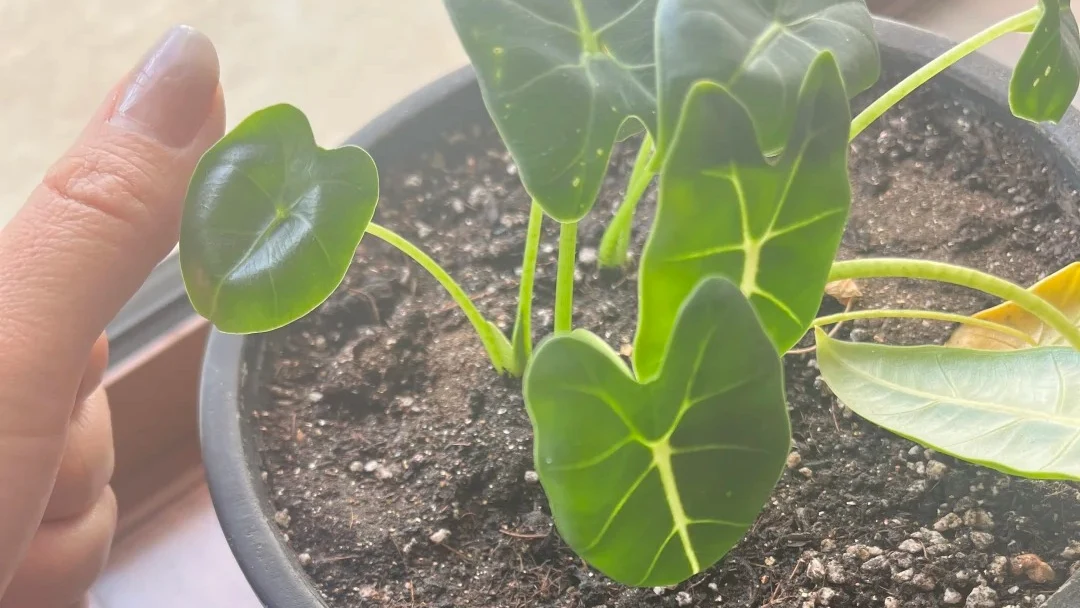
Some tropical plants replace leaves quickly. Caladium is a good example — it cycles foliage constantly during active growth. Seeing leaves fade while new ones emerge is simply how it manages energy.
Alocasia behaves in a similar way, but not to an extreme degree. A healthy plant usually maintains a fairly stable number of leaves. One new leaf comes in, one older leaf goes out.
What shouldn’t happen is losing multiple leaves for every new one. If the overall leaf count keeps shrinking, that’s not just natural turnover anymore — it’s often the same pattern you see when roots are stressed by consistently wet soil.
At that point, the issue isn’t aging. It’s imbalance — and with Alocasia, that imbalance almost always begins at the roots — and if you suspect rot, don’t guess from leaves alone.
What Normal Leaf Turnover Looks Like
Normal leaf turnover in Alocasia follows a pattern. Once you understand that pattern, it becomes much easier to tell whether something is actually wrong.
The biggest difference is between mature plants and younger ones.
A well-established, mature Alocasia usually operates in a “one in, one out” rhythm. When a new leaf fully unfurls and hardens off, an older leaf begins to yellow. The total leaf count stays relatively stable.
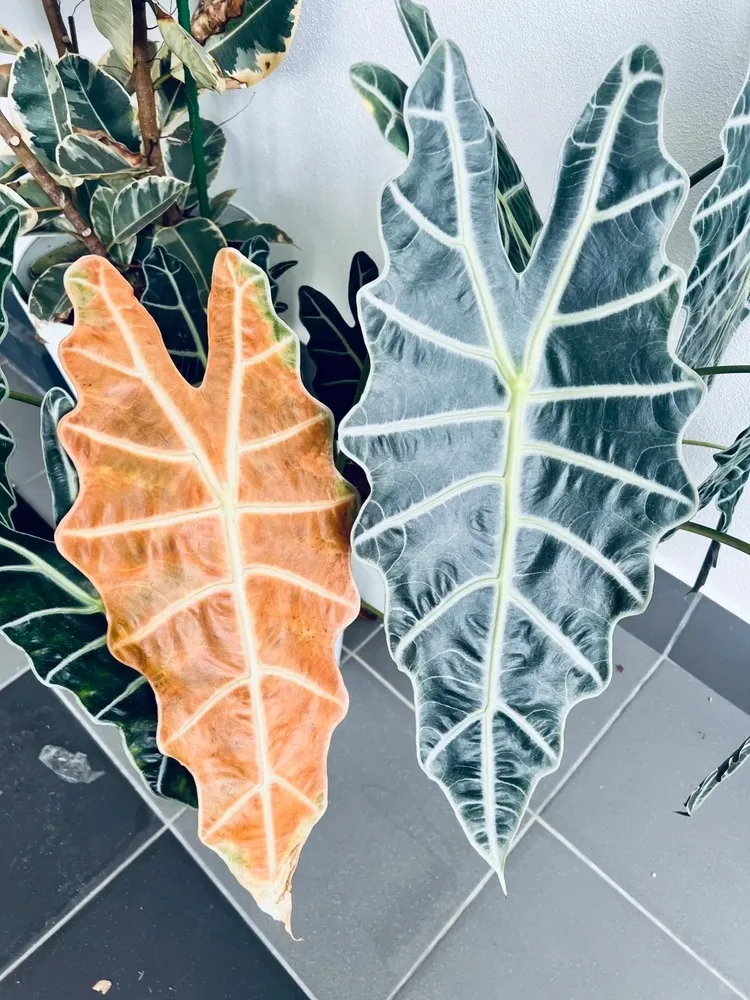
For example, my mature Alocasia Polly behaves exactly like this. A new leaf opens, settles, and only then does the oldest leaf start to decline. It’s predictable and steady.
Younger plants behave differently.
In their expansion phase, they are still building root mass and overall structure. Because of that, they often produce multiple new leaves before sacrificing an older one.
My younger Alocasia micholitziana ‘Frydek’, Alocasia sarian, and Alocasia baginda ‘Silver Dragon’ rarely drop a leaf for every new one. They may push out two or three leaves before a single older leaf fades.
Another detail to watch is timing.
In normal turnover, the older leaf doesn’t collapse suddenly. It slowly yellows after the new leaf has fully opened and begun photosynthesizing. There’s a transition period, not an abrupt loss.
If your plant follows this kind of rhythm, you’re looking at healthy energy management — not decline.
This baseline matters, because once the pattern changes, that’s when you start investigating.
When Leaf Loss Is Happening Too Fast
Leaf loss becomes a problem when the rhythm changes.
If your Alocasia grows two new leaves but loses four in the process, that is no longer normal turnover. The total leaf count is shrinking instead of stabilizing.
This usually means energy production is lower than energy demand. Sometimes it’s not just roots — low light can also reduce energy production and make leaf loss feel faster than it should.
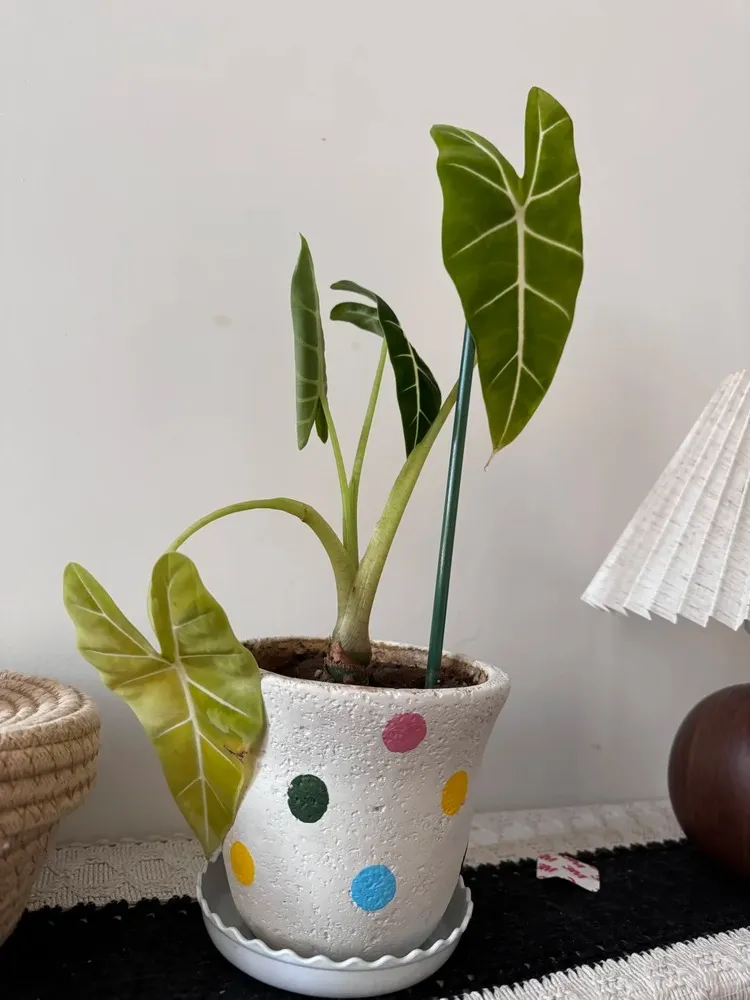
In simple terms, the plant cannot support the amount of growth it is attempting. Something underneath the soil line is limiting absorption.
Most of the time, that limitation starts with the roots.
Either the root system is not strong enough to support rapid top growth, or it has already been compromised. When roots cannot absorb water and nutrients efficiently, the plant sacrifices older leaves to survive.
Watering habits often play a role here — especially watering on a fixed schedule instead of letting the pot dry down.
Many growers assume that higher humidity means they can water more frequently. In reality, high humidity slows evaporation, which means the soil stays wet longer.
If you continue watering on a fixed schedule without allowing a true dry-down cycle, the roots remain constantly moist. Over time, that reduces oxygen availability in the root zone.
Roots need air as much as they need water.
When soil stays wet for too long, root activity slows. Absorption weakens. The plant responds by shedding older foliage to reduce demand.
Fertilizer imbalance can amplify the issue.
If you increase feeding to encourage growth while the roots are already stressed, the plant may push out new leaves temporarily. But without strong root support, older leaves decline faster than usual.
The visible symptom is leaf loss.
The underlying issue is almost always root efficiency.
Check the Roots Before You Do Anything Else
Before adjusting watering, fertilizer, or humidity, check the roots.
Alocasia leaf problems often look dramatic above the soil. But the real condition of the plant is almost always revealed below it.
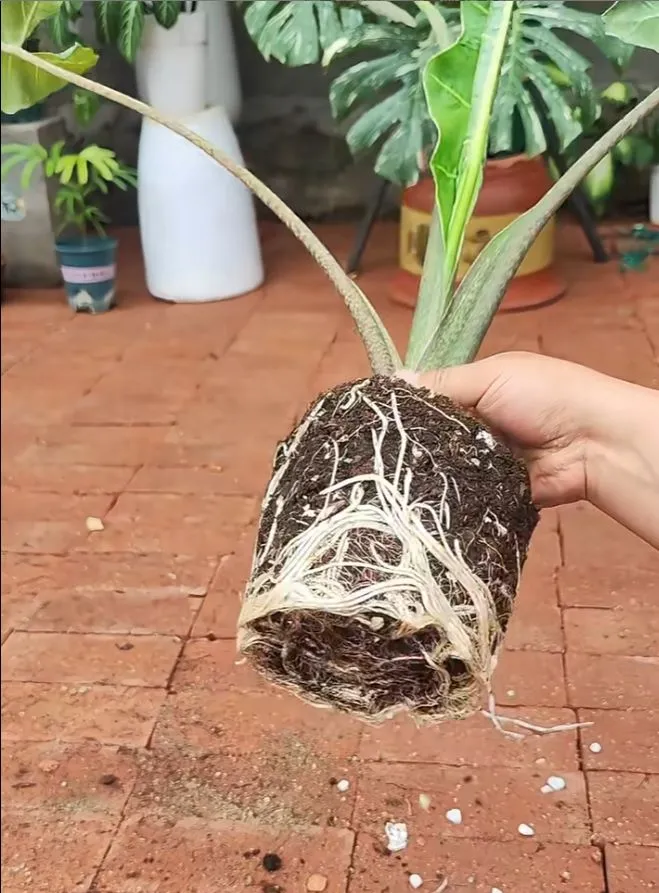
Start by gently removing the plant from its pot.
Support the base of the plant, tilt the pot sideways, and slide the root ball out in one piece. If the soil is very compacted, loosen it slowly rather than pulling forcefully on the stems.
Once exposed, examine the roots carefully.
Healthy Alocasia roots are firm and light in color. They should appear white to pale cream, sometimes slightly yellow, but still solid and structured.
They should not feel mushy when pressed.
Unhealthy roots look different.
If you see brown or dark yellow roots that feel soft, slimy, or hollow, that indicates rot. The outer layer may peel away easily, leaving a thin inner strand.
Smell also matters.
Healthy roots have little to no odor. Rotting roots often carry a sour or musty smell, especially near the base of the plant.
If the majority of the root system is white and firm, the plant is not suffering from active rot. In that case, excessive leaf loss is more likely related to watering rhythm or nutrient balance rather than root failure.
If the roots are soft, dark, or collapsing, the leaf loss is a symptom of root decline — not normal turnover.
Do not guess based on leaves alone.
Roots provide the answer.
If the Roots Are Healthy
If the root system looks firm, light-colored, and odor-free, the plant is not actively rotting. In that case, excessive leaf loss usually comes from environmental rhythm, not structural failure.
① Improve Airflow After Watering
Alocasia roots need oxygen as much as moisture. Even healthy roots can weaken if the soil stays damp for too long.
After watering, increase air movement around the plant. A small fan, air conditioning, or simply better room circulation helps the soil dry evenly and prevents stagnation.
Good airflow reduces the risk of subtle root stress that slowly leads to leaf loss.
② Restore a True Wet–Dry Cycle
Avoid frequent “small sips” of water.
Light surface watering keeps the top layer moist while the lower soil remains constantly damp. Over time, this reduces oxygen availability and weakens root efficiency.
Let the soil dry properly before watering again. Not bone dry for weeks — but dry enough that the pot feels lighter and the lower zone has had time to breathe.
A strong wet–dry cycle strengthens roots. Strong roots reduce unnecessary leaf sacrifice.
③ Feed Lightly, But Consistently
This is where many growers hesitate.
When I refreshed the soil and began feeding lightly but consistently, growth accelerated significantly. The plant produced seven to eight new leaves while only dropping two older ones.
The key was low concentration, applied regularly.
Instead of heavy feeding once in a while, use diluted fertilizer during active growth. A small amount with each watering (properly diluted) supports steady production without overwhelming the roots.
Fertilizer should support healthy roots — not force rapid top growth on a weak system.
If the Roots Are Not Healthy
If the roots appear soft, dark, or collapsing, the priority changes.
Stop fertilizing immediately.
Feeding a compromised root system will worsen stress.
Trim away damaged roots using clean tools. Remove any soft or decayed sections until only firm tissue remains.
Repot into fresh, well-draining soil. Avoid overly dense mixes that retain moisture for too long.
After repotting, reduce watering frequency. Allow the roots time to recover before resuming normal feeding.
If you need a step-by-step recovery process, see my full guide on fixing Alocasia root rot. That article walks through trimming, disinfecting, and rebuilding root strength properly.
The Hidden Cause: Watering Frequency
In many cases, excessive leaf loss is not caused by low humidity or aging leaves. The real trigger is watering frequency and how it affects root strength.
When soil stays consistently moist without a proper dry-down phase, oxygen levels in the root zone decrease. Over time, this weakens root absorption, even if the roots have not fully rotted.
As absorption efficiency drops, the plant cannot support both existing foliage and new growth at the same time. It begins reducing demand by shedding older leaves first.
This pattern is often mistaken for a humidity issue, but Humidity rarely causes rapid old leaf decline on its own — if leaves are yellowing fast, it’s usually more useful to read the pattern than chase humidity numbers. The more common issue is roots that never get a chance to breathe.
When watering rhythm improves and a true wet–dry cycle is restored, roots regain strength. Strong roots absorb more efficiently and maintain foliage more consistently.
Once root absorption stabilizes, older leaves are not discarded as quickly. In most healthy Alocasia, stable roots mean stable leaf count.
A Note About Growth Phase
Leaf behavior in Alocasia often depends on the plant’s growth phase. Without considering this, it’s easy to misinterpret normal shedding as a problem.
Young plants are still in expansion mode. They are actively building root mass and increasing their total leaf surface, which means growth usually outweighs loss during this stage.
In practical terms, that expansion phase often looks like this:
Young / Expanding Plants
- Produce two or three new leaves before sacrificing one
- Gradually increase total leaf count
- Show stronger top growth while roots are still developing
Mature plants behave differently.
Once fully established, they shift into a maintenance rhythm. Instead of expanding aggressively, they tend to stabilize.
That stable phase typically looks like this:
Mature / Established Plants
- Follow a “one new leaf, one old leaf” pattern
- Maintain a relatively consistent leaf count
- Show predictable, slower growth cycles
Because mature plants are no longer focused on rapid expansion, heavy leaf loss is less likely to be normal. If a well-established Alocasia begins shedding multiple leaves during active growth, that usually signals imbalance rather than natural turnover.
Growth phase explains the rhythm, but it doesn’t excuse decline. When a mature plant loses leaves faster than it produces them, root strength and watering rhythm should be evaluated.
Understanding which phase your plant is in gives context. Not all shedding is a warning — but in the wrong phase, it often is.
Leaf turnover is part of how Alocasia manages energy.
The key is recognizing whether your plant is following a healthy rhythm or signaling stress below the soil.
When you understand that difference, leaf loss becomes information — not anxiety.
FAQ
If the total number of leaves is steadily decreasing, however, that suggests imbalance rather than normal cycling.
Once a new leaf fully unfurls and begins photosynthesizing, the plant may no longer need to support its oldest leaf. As long as the overall leaf count stays stable and the roots are healthy, this pattern is normal.
The timing matters more than the yellowing itself.
Roots don’t need to be visibly rotting to be underperforming. If the soil stays constantly moist, oxygen levels drop and absorption efficiency declines. The plant may shed older leaves simply because the roots cannot sustain full foliage load.
This is why watering rhythm matters as much as root appearance.
If root absorption is weak, increasing fertilizer can temporarily push new growth but accelerate old leaf decline. Feeding only works when the root system is strong enough to process nutrients effectively.
Always check root health and watering rhythm before adjusting fertilizer levels.
If the plant is steadily increasing its total leaf count over several growth cycles, it is likely still expanding. If the leaf count stays consistent and follows a predictable replacement rhythm, it has probably reached a stable phase.
Growth phase helps you interpret whether shedding is normal or excessive.
Alocasia will always replace older foliage over time. The goal isn’t to prevent leaf loss entirely — it’s to maintain balance.
A healthy plant may shed occasionally, but it shouldn’t decline faster than it grows. When roots are strong and watering rhythm is stable, leaf turnover becomes gradual and predictable.
Trouble with your Alocasia?
Find real fixes for yellow leaves, drooping stems, and root issues in our Problems Hub.
Go to Problems Hub →