Holes and tears on Alocasia leaves don’t automatically mean pests or disease. While damaged foliage often triggers concern, most cases follow a small number of repeatable patterns rather than random failure.
What matters is not the hole itself, but whether the damage keeps appearing. A single torn or perforated leaf can be the result of timing, movement, or physical stress during growth — and may never happen again.
👉 Persistence matters more than shape.
When damage repeats on new leaves, it signals an active cause. When it doesn’t, the leaf is usually just telling a past story — not a current problem.
What Holes and Tears Usually Look Like on Alocasia
Holes and tears on Alocasia leaves tend to show up in a few familiar visual forms, but their appearance alone rarely tells the full story.
Some leaves develop round or semi-round holes, often clean-edged and scattered across the blade. These can look intentional, almost like bite marks, which is why they’re frequently blamed on pests at first glance.
Others show tears that follow the direction of the veins. These splits usually appear linear or elongated, as if the leaf has been pulled apart from the inside. When the leaf is fully expanded, the damage can look dramatic — even though it may have happened long before the leaf ever opened.
You may also see irregular missing sections, where the edges look uneven or jagged. These areas don’t follow a clear pattern and often appear suddenly, making them easy to misinterpret as active damage.
The key thing to understand is this:
👉 these visual patterns are not diagnoses.
On Alocasia, similar-looking holes or tears can come from completely different processes — some active, some long finished. Shape alone doesn’t tell you whether the cause is ongoing, accidental, or already over.
This section isn’t about naming the cause. It’s about recognizing that appearance by itself is not enough — and that jumping to conclusions based on hole shape is where most misjudgments begin.
Insect Damage (Uncommon, But Very Specific)
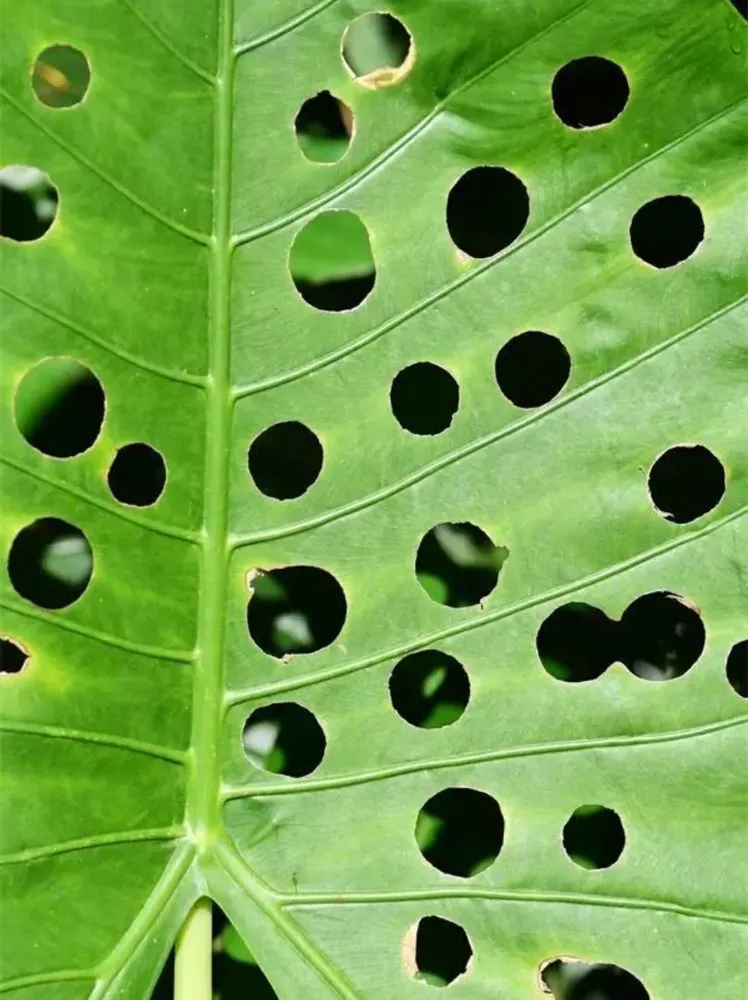
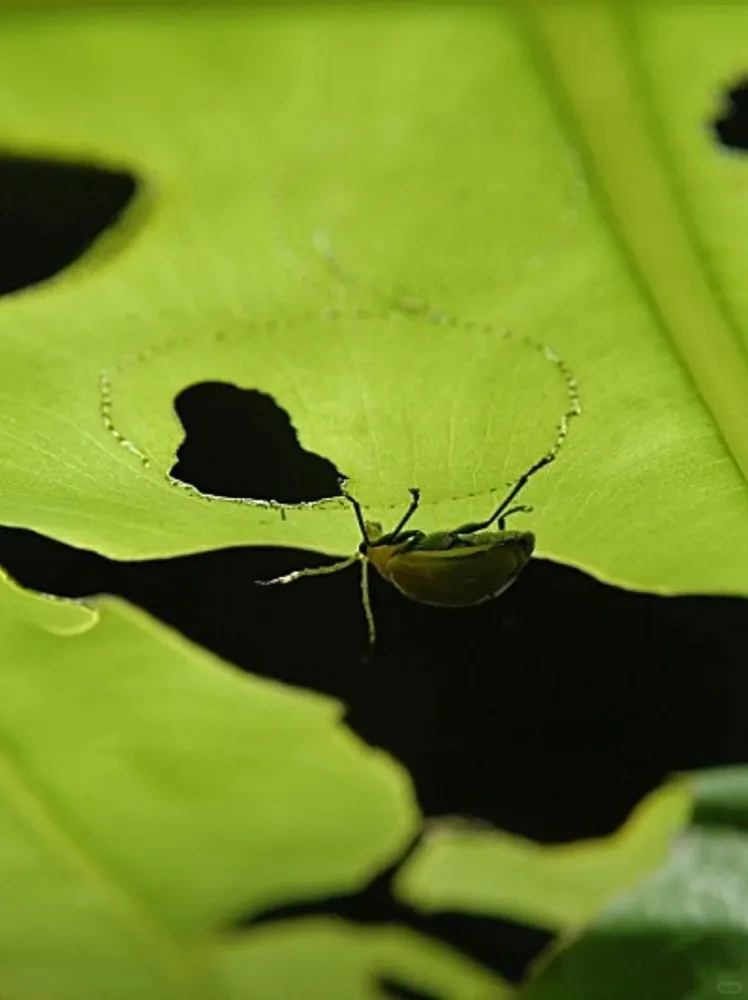
Insect damage on Alocasia is far less common than people assume — but when it does happen, it tends to follow a very specific pattern. This is why it deserves attention, but not panic.
What Real Insect Damage Looks Like
True insect damage usually shows up as round or semi-round holes punched directly through the leaf blade. The edges often look surprisingly clean, not shredded or torn.
More importantly, these holes don’t stay isolated. When pests are involved, similar holes appear on multiple leaves, often across both older and newer growth. The pattern repeats, even if the size or exact position varies.
That repetition is the giveaway. One leaf with holes is ambiguous. Several leaves developing new holes over time is not.
Why the Holes Can Look “Clean”
Alocasia leaves contain defensive compounds that make them unappealing — and even toxic — to many animals. When the leaf tissue is damaged, these substances move along the veins toward the injured area.
If an insect slowly grazes along the leaf surface, those compounds continue to accumulate at the feeding site, increasing the chance the insect is affected. But some beetle-type insects avoid this by using strong mandibles to cut through the leaf first, separating a piece of tissue before consuming it.
This cutting behavior limits how much defensive material reaches the feeding area, which is why the resulting holes can look precise, round, and sharply edged rather than ragged. Clean holes don’t mean gentle damage — they often mean efficient damage.
How to Confirm It’s Actually Pests
There’s one test that matters more than anything else:
👉 Does the damage keep happening?
Insect damage is defined by continuity, not appearance. New holes will appear on leaves that were previously intact. The plant doesn’t stabilize on its own, and the pattern repeats even after damaged leaves are removed.
If the holes stop appearing, it wasn’t an active pest issue — regardless of how “insect-like” the original damage looked.
On Alocasia, pest damage is never a one-time event.
If it’s real, it’s persistent.
Mechanical Damage (The Most Common Cause)
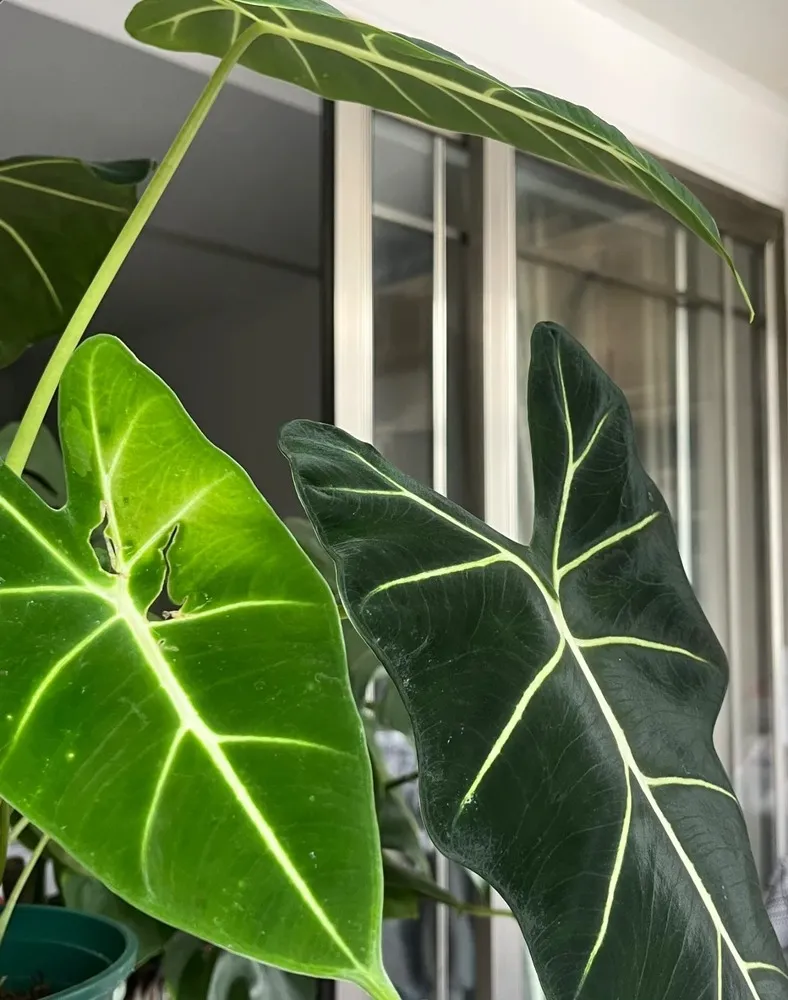
Mechanical damage is, by far, the most common reason Alocasia leaves end up with holes or tears — and also the most misunderstood.
When This Happens
This type of damage almost always occurs during leaf expansion, when new leaves are still soft, folded, or only partially unfurled.
Typical triggers include:
- Moving the plant while new leaves are emerging
- Brushing against developing leaves without noticing
- Rearranging nearby plants in a crowded indoor space
At this stage, the leaf tissue hasn’t fully strengthened. Even light pressure can crease, pinch, or puncture it — damage that may be invisible at first.
My Experience: One Leaf, One Time
I’ve seen this happen firsthand.
In one case, a velvet Alocasia had several leaves in the process of unfurling. During routine rearranging, I moved the pot without realizing a young leaf was pressed or bent. At the time, nothing looked wrong.
Days later, when the leaf fully opened, a clean hole appeared in the blade.
What mattered most wasn’t the hole itself — it was what didn’t happen next.
No new holes formed. Other leaves stayed intact. New growth emerged normally. The damage never repeated.
That one leaf carried the mark permanently, but the plant as a whole was unaffected.
Why Mechanical Damage Doesn’t Spread
Mechanical damage is defined by one key trait:
👉 It is a one-time event.
There is no progression, no pattern, and no repeat appearance on newer leaves. Once the leaf finishes expanding, the damage is “locked in” — it cannot grow, spread, or infect surrounding tissue.
This is why continuity matters more than shape.
A hole caused by physical contact may look dramatic, even alarming, but if it appears once and never again, it isn’t a health problem. It’s a historical record of a moment when the leaf was vulnerable.
On Alocasia, this kind of damage is cosmetic, not systemic. If the plant is also showing curled or sagging foliage, that’s a separate signal worth checking: alocasia leaves drooping / alocasia leaves curling.
👉 One leaf, one time = mechanical damage.
Low Humidity During Unfurling
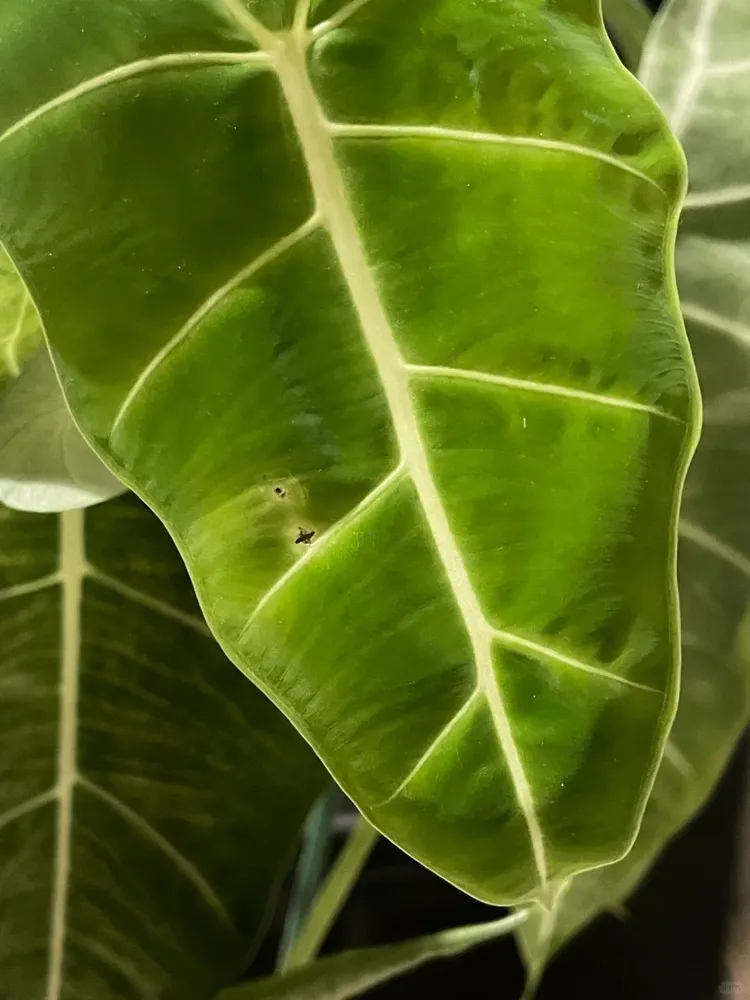
Low humidity can cause holes or tears on Alocasia leaves — but only at a very specific moment: during unfurling.
What Happens in Dry Air
When a new Alocasia leaf is emerging, the tissue is thin, flexible, and still forming its final structure. If the surrounding air is too dry at this stage, the leaf surface loses moisture faster than it can expand.
The result isn’t decay — it’s friction.
As the leaf tries to open, parts of it stick, resist, or pull unevenly, especially along veins or folded edges. Once the tension is released, small splits, cracks, or holes appear.
The damage becomes visible only after the leaf fully opens, which often makes it feel sudden or mysterious.
Why It Only Affects One Leaf
This type of damage is time-locked.
It only affects the leaf that was unfolding during that dry period. Once humidity returns to normal, the next leaf forms under better conditions and opens cleanly.
There is no spread. No progression. No pattern across the plant.
That’s the key distinction.
If the holes or tears appear only on one newly opened leaf, and newer leaves are normal, low humidity during unfurling is a strong candidate.
👉 It’s not an ongoing problem — it’s a snapshot of a bad moment.
In Alocasia, dry-air damage leaves marks, not momentum.
A hole or tear on an Alocasia leaf isn’t automatically a problem.
What matters is repetition. Damage that keeps appearing points to an active issue. Damage that happens once usually doesn’t.
The real skill isn’t fixing every mark — it’s knowing when not to react.
One damaged leaf tells you very little.
New growth tells you almost everything.
FAQ
If new leaves are intact, firm, and hole-free, the problem is no longer active.
👉 New growth matters more than old damage.
Trouble with your Alocasia?
Find real fixes for yellow leaves, drooping stems, and root issues in our Problems Hub.
Go to Problems Hub →